
The Acoustic Velocity of the Flap-T: How Top Executives Link Words Without Friction
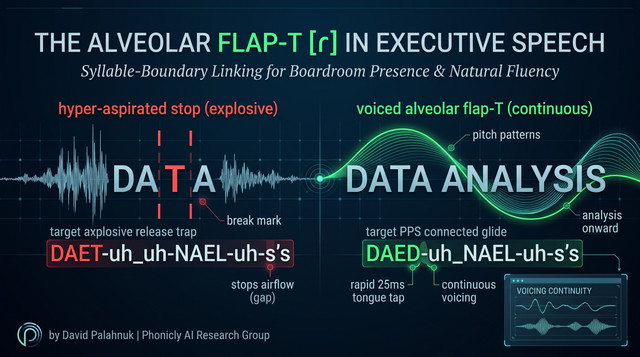
When non-native leaders present quarterly metrics or strategic roadmaps, one consonant consistently betrays textbook training: the intervocalic T. Pronouncing the letter T with a crisp, British-style aspirated burst between two vowels immediately halts airflow and interrupts your cadence.
In General American English (GAE), authoritative speakers replace that abrupt stop with the voiced alveolar flap [ɾ]—a rapid, single-tap tongue movement that sounds like a soft, frictionless D and preserves continuous vocal momentum.
Why the Aspirated T Creates Acoustic Friction
- Airflow Interruption: Forming a full voiceless stop [t] forces the vocal folds to stop vibrating for 60 to 90 milliseconds, creating an audible gap in the middle of high-frequency words like data, capital, and meeting.
- Voiced Continuity: Executing an alveolar flap keeps the vocal folds vibrating continuously while the tongue tip briefly taps the alveolar ridge, maintaining an unbroken fundamental frequency (F0) contour.
Executive Terminology in PPS Flap-T Notation
- Data Analysis → "DEI-d’_nn-NAE-l’-sihs"
- Global Strategy → "GLOU-b'l_STRAE-d'-jee"
- Capital Allocation → "KAE-p'-d/l_ae-l'-KEI-sh'n"
- Better Outcome → "BEH-d'r_AUT-k'm"
Three Steps to Calibrate Your Flap-T
- Spot the Vowel-T-Vowel Trigger: Whenever a T sits between two vowel sounds—either inside a word (strategy) or across a word boundary (get it)—switch from an air burst to a light tongue tap.
- Minimize Tongue Pressure: Do not press the tongue flat against the roof of the mouth. Flick the very tip upward for less than 30 milliseconds so the vowel resonance never stops.
- Benchmark on Phonicly: Practice the sentence: "Our data analysis drives a better capital strategy," and track your voicing continuity score.
Replacing heavy intervocalic stops with a frictionless alveolar flap transforms hesitant pronunciation into effortless executive velocity.